Unetwork License Splits Explained: 50/50 vs 40/60 vs 30/70
· 15 min read · Unetwork Guide
Every Unetwork license comes with a reward split that determines how earnings are divided between the license owner (UNO) and the operator (ULO) running it on their phone. The split you choose directly affects how much you earn each month. Understanding the differences between 50/50, 40/60, and 30/70 is one of the most important decisions you will make as a Unetwork operator.
Most license providers only offer a single split option. Our competitor at unetworklicenses.com, for example, exclusively offers 40/60 splits. At unetworklicense.com, we offer all three standard splits: 50/50, 40/60, and 30/70. That means operators can choose the split ratio that matches their goals, whether that is maximizing monthly earnings or finding a balance that works for both owner and operator.
This guide breaks down exactly how each Unetwork license split works, shows you the real math at current and projected earning rates, and helps you decide which split makes the most sense for your situation.
What Is a Unetwork License Split?
A Unetwork license split is the agreed percentage that determines how rewards are divided between the node owner (UNO) and the license operator (ULO). Every time a license earns UPs (Unetwork Points, where 1 UP equals 1 USD), the earnings are automatically distributed according to the split ratio attached to that license.
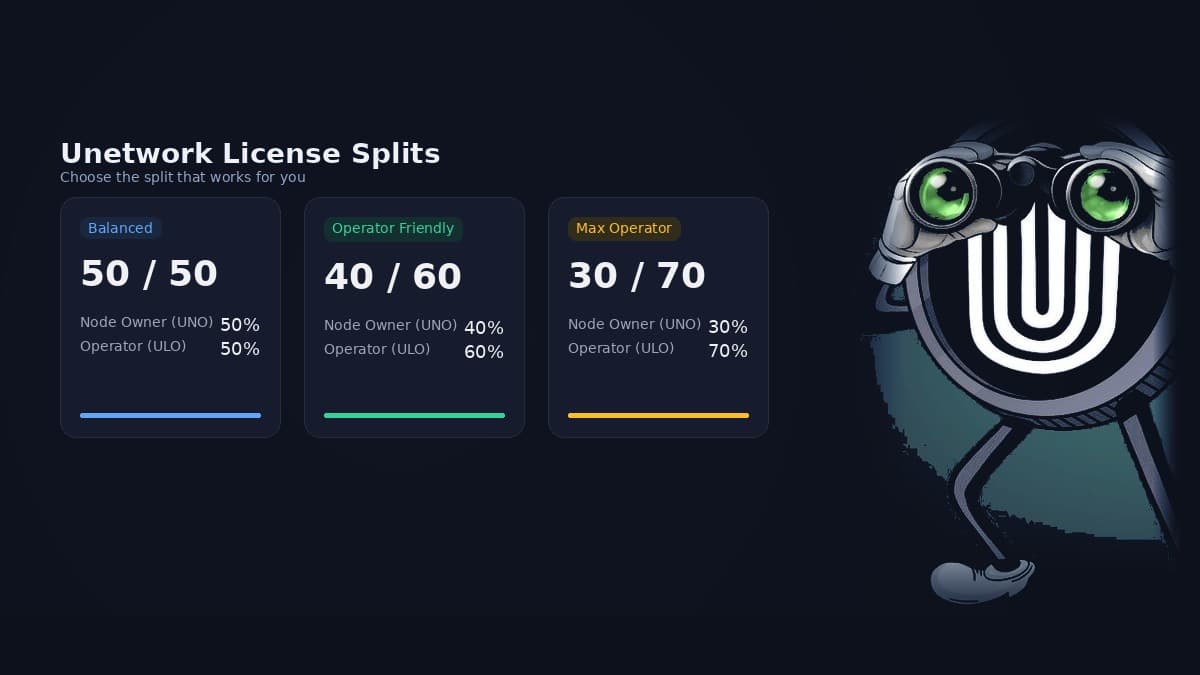
The split format is always written as UNO/ULO, meaning the first number is the owner's share and the second number is the operator's share. So a 50/50 split means the owner gets 50% and the operator gets 50%. A 40/60 split means the owner gets 40% and the operator gets 60%. A 30/70 split means the owner gets 30% and the operator gets 70%.
This system exists because Unetwork separates license ownership from license operation. A Unetwork Node Owner (UNO) purchases a node containing 200 licenses but may not have 200 phones or may not live in a region where telecom tasks are available. The UNO leases individual licenses to Unetwork License Operators (ULOs) who run them on their smartphones in active markets like the Philippines, India, Nigeria, and Thailand. The split is the mechanism that compensates both parties for their respective contributions.
The owner contributes the license itself, which required an upfront investment. The operator contributes the phone, the mobile data connection, the physical presence in a coverage area, and the effort of keeping the device online and completing tasks. The split reflects the value each side brings to the arrangement.

How Does the 50/50 Split Work?
The 50/50 split divides all license earnings equally between the node owner and the operator. For every dollar the license earns, the owner receives $0.50 and the operator receives $0.50. This is the most balanced split available and represents an equal partnership between UNO and ULO.
At current earning rates of approximately $7 per month per license, a 50/50 split generates $3.50 per month for the operator and $3.50 per month for the owner. When Scout and Runner tasks launch and projected earnings reach approximately $48 per month per license, the operator would earn $24 per month and the owner would earn $24 per month.
| 50/50 Split Breakdown | Owner (UNO) | Operator (ULO) |
|---|---|---|
| Percentage | 50% | 50% |
| Current earnings ($7/mo) | $3.50 | $3.50 |
| Projected earnings ($48/mo) | $24.00 | $24.00 |
The 50/50 split is often the default choice for operators who are new to Unetwork. It feels fair and straightforward. The owner invested money to buy the license, and the operator invests time, a device, and data to run it. Both sides share equally in whatever the license produces.
From the owner's perspective, the 50/50 split maximizes their return per license. They retain half of all earnings, which helps offset the initial cost of purchasing a node. For a Round 1 node purchased at $5,000 (200 licenses), keeping 50% of every license's earnings accelerates the path toward breakeven.
From the operator's perspective, the 50/50 split is the lowest earning option among the three available splits. The operator does all the active work: keeping the phone charged, maintaining a data connection, staying in coverage areas, and granting the app permissions it needs. Some operators feel that equal earnings do not reflect the unequal effort. Others view the zero upfront cost of leasing as fair compensation for taking a smaller share.
How Does the 40/60 Split Work?
The 40/60 split gives the operator 60% of all license earnings while the owner retains 40%. This tilts the reward structure in favor of the person doing the active work of running the license on their phone.
At current earning rates of approximately $7 per month per license, a 40/60 split generates $4.20 per month for the operator and $2.80 per month for the owner. At projected earnings of $48 per month, the operator would receive $28.80 per month and the owner would receive $19.20 per month.
| 40/60 Split Breakdown | Owner (UNO) | Operator (ULO) |
|---|---|---|
| Percentage | 40% | 60% |
| Current earnings ($7/mo) | $2.80 | $4.20 |
| Projected earnings ($48/mo) | $19.20 | $28.80 |
The 40/60 split is the most widely offered option in the Unetwork ecosystem. It is the only split available from our competitor at unetworklicenses.com, which makes it the default for many operators who have not explored other options. The 40/60 split represents a reasonable middle ground: owners still earn a meaningful share, while operators receive a premium for their active contribution.
Node owners often choose to offer 40/60 splits when they want to attract operators in competitive markets. If an operator has the choice between a 50/50 license and a 40/60 license, the 40/60 license puts more money in their pocket every month. Owners who are focused on filling all 200 licenses quickly may prefer the slightly lower per license return in exchange for getting all their licenses operational and earning.
For operators, the 40/60 split is a solid upgrade from 50/50. The jump from $3.50 to $4.20 per month at current rates may seem small, but it adds up across multiple licenses and compounds significantly when projected earnings increase. An operator running 5 licenses at 40/60 earns $21 per month instead of $17.50 at 50/50. That is $42 more per year from the same effort.
How Does the 30/70 Split Work?
The 30/70 split gives the operator 70% of all license earnings, the highest operator share available. The node owner retains just 30%. This is the most operator friendly split in the Unetwork system and is exclusively available through select license providers like unetworklicense.com.
At current earning rates of approximately $7 per month per license, a 30/70 split generates $4.90 per month for the operator and $2.10 per month for the owner. At projected earnings of $48 per month, the operator would receive $33.60 per month and the owner would receive $14.40 per month.
| 30/70 Split Breakdown | Owner (UNO) | Operator (ULO) |
|---|---|---|
| Percentage | 30% | 70% |
| Current earnings ($7/mo) | $2.10 | $4.90 |
| Projected earnings ($48/mo) | $14.40 | $33.60 |
The 30/70 split is the premium option for operators who want to maximize their earnings. Not every license provider offers this split. In fact, most providers and competitors only offer 40/60 or 50/50. The 30/70 option exists because some node owners prioritize network participation and license utilization over maximizing their own per license return.
From the owner's perspective, offering 30/70 splits makes strategic sense in several scenarios. If an owner has struggled to fill licenses at 50/50 or 40/60, the 30/70 split attracts operators who might otherwise pass. Owners who purchased Round 1 nodes at $5,000 (compared to $10,000 for Round 2) have lower cost bases and can afford to offer more generous splits while still earning a return. Some owners also view 30/70 as a long term play: get licenses into operators' hands now, build relationships, and benefit when projected earnings of $48 per month become reality.
For operators, the 30/70 split is the clear winner for monthly income. The $4.90 per month at current rates is 40% more than the $3.50 earned on a 50/50 split. Across 10 licenses, that difference grows to $14 per month or $168 per year. At projected earnings of $48 per month, the gap widens even further: $33.60 per month at 30/70 versus $24 per month at 50/50, a difference of $9.60 per license per month.

Which Split Should You Choose as an Operator?
The best split for you depends on your priorities, your market, and how many licenses you plan to run. There is no universally correct answer, but the data points clearly toward higher operator shares being better for the person doing the work.
Choose 30/70 if you want maximum earnings. This is the straightforward case. If two licenses are available and one is 30/70 while the other is 50/50, the 30/70 license puts 40% more money in your pocket every single month. Over a year, that adds up to significant additional income. The 30/70 split is especially valuable for operators in developing markets where every dollar of monthly income matters. An operator in the Philippines running 5 licenses at 30/70 earns $24.50 per month at current rates, compared to $17.50 at 50/50. That $7 monthly difference buys real groceries.
Choose 40/60 if 30/70 is not available. The 40/60 split is a good middle ground and the most common option across the Unetwork ecosystem. It pays operators meaningfully more than 50/50 while still leaving enough for the owner to justify leasing. If you are comparing offers from different license providers and 40/60 is the best available, it is a solid choice.
Choose 50/50 only if no better splits are available. While the 50/50 split is perfectly fair in principle, you are leaving money on the table if 40/60 or 30/70 options exist. The only scenario where 50/50 makes strong sense for an operator is when it comes with other benefits, such as a particularly reliable owner, a license in a high task density region, or an agreement that includes flexibility to renegotiate later.
One important note: the split only affects how earnings are divided. It does not affect how many tasks your phone receives, how much each task pays, or any other aspect of the Unetwork experience. A license with a 30/70 split earns the same gross amount as a license with a 50/50 split. The only difference is how that gross amount is divided between owner and operator.
How Do the Three Splits Compare Side by Side?
The full comparison table below shows operator earnings across all three splits at both current and projected earning rates. These numbers represent a single license. Multiply by the number of licenses you run to calculate your total monthly income.
| Split (UNO/ULO) | Owner Share | Operator Share | Operator Earns (Current $7/mo) | Operator Earns (Projected $48/mo) |
|---|---|---|---|---|
| 50/50 | 50% | 50% | $3.50 | $24.00 |
| 40/60 | 40% | 60% | $4.20 | $28.80 |
| 30/70 | 30% | 70% | $4.90 | $33.60 |
The difference between splits becomes more dramatic at scale. Here is what the numbers look like for an operator running 5 licenses and 10 licenses at current rates:
| Split | 1 License/mo | 5 Licenses/mo | 10 Licenses/mo | 10 Licenses/yr |
|---|---|---|---|---|
| 50/50 | $3.50 | $17.50 | $35.00 | $420.00 |
| 40/60 | $4.20 | $21.00 | $42.00 | $504.00 |
| 30/70 | $4.90 | $24.50 | $49.00 | $588.00 |
An operator running 10 licenses at 30/70 earns $588 per year compared to $420 per year at 50/50. That is $168 more annually from the same phones, the same effort, and the same tasks. The only difference is the split printed on the license.
At projected earnings of $48 per month per license, the gap becomes even larger. An operator running 10 licenses at 30/70 would earn $336 per month ($4,032 per year) compared to $240 per month ($2,880 per year) at 50/50. The annual difference of $1,152 is meaningful income in any market.
We Offer 50/50, 40/60, and 30/70 Splits
Unlike competitors who only offer 40/60, our license directory lets you choose the split that fits your goals.
Can You Switch Splits After Claiming a License?
No, the split is locked in when the license is claimed by the operator. Once you enter a lease code and activate a license in the Unetwork app, the split ratio attached to that license is permanent for the duration of the lease. You cannot change a 50/50 license to a 40/60 or 30/70 after claiming it.
This is why choosing the right split before claiming is so important. Take the time to compare available options before entering any lease code. If you have already claimed a license at 50/50 and later discover that 30/70 options exist, you would need to release your current license and claim a new one with the preferred split. The exact process for releasing a license depends on the arrangement with your node owner, so communicate clearly before making changes.
From a practical standpoint, the best approach is to browse all available licenses, compare splits, and pick the highest operator share you can find before claiming anything. Our license directory clearly labels every license with its split ratio so you can make an informed decision upfront.
Why Do Different Splits Exist?
Different splits exist because node owners and operators have different economic situations, goals, and risk tolerances. A one size fits all split would limit the network's ability to attract participants on both sides of the equation.
Node owners have varying cost bases. A Round 1 node owner paid $5,000 for 200 licenses, while a Round 2 node owner paid $10,000 for the same number of licenses. The Round 1 owner can afford to offer more generous splits because their cost per license is half as much. A Round 2 owner might need to keep a larger share to justify their investment, leading them to offer 50/50 splits instead of 30/70.
Market conditions vary by region. In markets with many operators competing for licenses (like the Philippines), owners may offer 50/50 splits knowing that demand is high and operators will accept equal splits. In markets where Unetwork is less established and operators are harder to find, owners offer 40/60 or 30/70 to attract participants. The split becomes a tool for balancing supply and demand.
Owner strategies differ. Some owners want to maximize income per license. They offer 50/50 and accept that it may take longer to fill all 200 licenses. Other owners prioritize getting every license operational as quickly as possible. They offer 30/70 splits, accept a lower per license return, but ensure all 200 licenses are earning something rather than sitting idle. An unused license earns zero for everyone. Even a 30/70 split generates income for the owner.
Operator loyalty matters.Owners who offer 30/70 splits tend to attract operators who are more committed and maintain higher uptime. An operator earning $4.90 per month from a license has more incentive to keep their phone charged, connected, and running than an operator earning $3.50. Better uptime means more tasks completed, which means more total earnings for both owner and operator. The higher operator share can actually increase the owner's absolute earnings by improving license performance.
What Happens to Earnings When Scout and Runner Tasks Launch?
Projected monthly earnings per license are expected to increase from approximately $7 to approximately $48 when Scout and Runner tasks fully launch across the network. This projection is based on the additional task volume and higher per task payouts that mobility based tasks (walking and driving) generate compared to passive Connection tasks alone.
At $48 per month per license, the dollar difference between splits becomes substantial. Here is the projected comparison:
| Split | Operator Monthly (1 License) | Operator Monthly (5 Licenses) | Operator Monthly (10 Licenses) |
|---|---|---|---|
| 50/50 | $24.00 | $120.00 | $240.00 |
| 40/60 | $28.80 | $144.00 | $288.00 |
| 30/70 | $33.60 | $168.00 | $336.00 |
At projected rates, an operator running 10 licenses at 30/70 would earn $336 per month compared to $240 per month at 50/50. That is $96 more every month, or $1,152 more per year. The percentage difference between splits stays the same, but the absolute dollar impact grows proportionally with the per license earning rate.
It is important to note that projected earnings are not guaranteed. The $48 figure is based on expected task volumes when Scout and Runner tasks are widely available. Actual results will depend on task density in your region, your uptime, and how actively you participate in mobility tasks. Current earnings of approximately $7 per month are the verified baseline. Use projected numbers for planning, but make decisions based on what you can earn today.

How Does the Unetwork License Split Affect Node Owners?
Node owners face a strategic tradeoff when choosing which splits to offer. A higher owner share (50/50) means more revenue per active license, but a lower owner share (30/70) tends to fill licenses faster and attract more committed operators. The optimal strategy depends on the owner's specific situation.
Consider a node with 200 licenses. If the owner offers all licenses at 50/50 but only fills 120 of them, the owner earns 120 multiplied by $3.50, which equals $420 per month at current rates. If the same owner offers 30/70 and fills all 200, they earn 200 multiplied by $2.10, which equals $420 per month. The total is identical, but the 30/70 scenario has every license working and building network value.
Many experienced node owners use a mixed approach. They offer some licenses at 50/50 for operators who want the standard arrangement, some at 40/60 for competitive markets, and some at 30/70 to attract operators in underserved regions or to fill the last remaining licenses. This diversified strategy balances income optimization with license utilization.
At unetworklicense.com, we offer licenses across all three split tiers. This gives operators the freedom to choose and gives the overall node operation the flexibility to reach full utilization. A fully utilized node earning at mixed splits generates more total value than a partially utilized node stuck at a single split.
Where Can You Find Unetwork Licenses with Different Splits?
Finding licenses with your preferred split requires checking multiple sources, but some providers make it significantly easier than others. Not all license providers offer all three splits, which limits your options if you only look in one place.
unetworklicense.com (this site) offers licenses at all three splits: 50/50, 40/60, and 30/70. Our license directory clearly labels each available license with its split ratio, so you can filter and compare before claiming. This is the only provider we are aware of that offers all three options in a single directory.
unetworklicenses.com(our competitor, note the extra "s") offers licenses exclusively at the 40/60 split. If you are looking for 50/50 or 30/70 options, they will not have them. The 40/60 split is a reasonable option, but operators who want to maximize earnings or compare across splits will need to look elsewhere.
Community channels on Telegram, Discord, and social media groups also have node owners offering licenses at various splits. The quality and reliability of these offers varies. Working with established license providers with a track record and a clear directory reduces the risk of miscommunication about splits.
Regardless of where you get your license, always confirm the split before entering the lease code. The split is visible in the Unetwork app when you enter a code, so verify it matches what was advertised. Once you claim the license, the split is locked.
Ready to Choose Your Split?
Pick the split that maximizes your earnings. Our directory has all three options available right now.
Frequently Asked Questions
What does the Unetwork license split format mean?
The split format is always written as UNO/ULO, where the first number is the node owner's percentage and the second number is the operator's percentage. For example, 40/60 means the owner gets 40% and the operator gets 60% of all earnings from that license. The split applies automatically to every UP earned.
Which Unetwork license split pays operators the most?
The 30/70 split pays operators the most. At current earnings of $7 per month per license, an operator on a 30/70 split earns $4.90 per month compared to $4.20 at 40/60 and $3.50 at 50/50. At projected earnings of $48 per month, the 30/70 operator earns $33.60 per month.
Can I change my Unetwork license split after claiming?
No. The split is locked in when you claim the license by entering the lease code in the Unetwork app. To switch to a different split, you would need to release your current license and claim a new one with the desired split ratio. Always verify the split before entering any lease code.
Does the split affect how many tasks my phone receives?
No. The split only determines how earnings are divided between the owner and operator. It does not affect task frequency, task types, or the gross amount the license earns. A 30/70 license and a 50/50 license both receive the same tasks and earn the same total UPs. The only difference is the distribution of those UPs.
Why does unetworklicenses.com only offer 40/60 splits?
Different license providers choose different strategies. Our competitor at unetworklicenses.com has standardized on the 40/60 split for all their licenses. At unetworklicense.com, we offer 50/50, 40/60, and 30/70 splits so operators can choose the option that best fits their situation and earning goals.
How much more does a 30/70 operator earn compared to 50/50?
A 30/70 operator earns 40% more than a 50/50 operator on the same license. At current rates of $7 per month, that is $4.90 versus $3.50, a difference of $1.40 per license per month. Across 10 licenses, the difference grows to $14 per month or $168 per year. At projected rates of $48 per month, the difference is $9.60 per license per month, or $1,152 per year across 10 licenses.
What is a Unetwork Node and how does it relate to splits?
A Unetwork Node is a bundle of 200 licenses purchased by a node owner (UNO). The owner sets the split ratio on each license before leasing it to operators (ULOs). Round 1 nodes cost $5,000 and Round 2 nodes cost $10,000. The split determines how earnings from each of those 200 licenses are divided between the owner and the operators running them.
Are projected earnings of $48 per month guaranteed?
No. The $48 per month figure is a projection based on expected task volumes when Scout and Runner tasks fully launch. Current verified earnings are approximately $7 per month per license. Actual future earnings will depend on task availability in your region, network growth, telecom partner demand, and your device uptime. Use projected numbers for planning purposes only.